
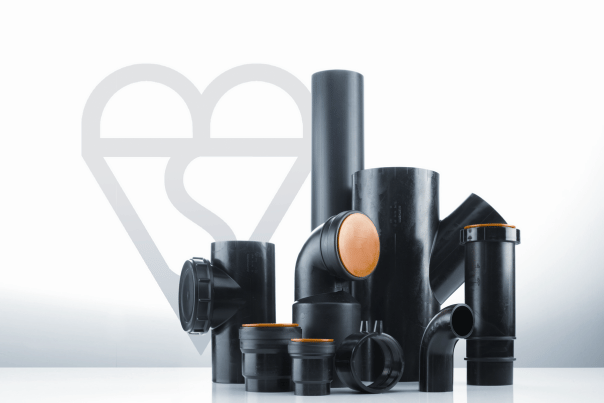
Britain has an ageing foul water system with many pipes dating back to Victorian times, or even older. Traditional materials include cast iron, concrete, clay, copper or even lead, but such systems are prone to corrosion, leakage, and premature failure. However, high-density polyethylene (HDPE) is a modern alternative that provides a host of benefits and is proving to be reliable, cost-effective and sustainable.
This material is proving especially effective in foul water drainage systems, which is why Aliaxis UK launched its own CIBSE approved Continuing Professional Development (CPD) programme that examines the benefits of HDPE in drainage systems.
Polyethylene (PE) was first discovered in 1933 by ICI and patented in 1937. It was introduced into the utility market in the 1960s and into building services for drainage in the 1980s.
PE is produced using a number of different processes leading to a number of different classifications; low, medium and high density, which means it has a high level of consistency in pipe quality and performance. It is a thermoplastic polymer that’s tough, lightweight and flexible. It is highly resistant to corrosion as well as resistant to high and low temperatures, coping with a range from -40°C to 100°C, which is only recommended for very brief discharge periods of less than two minutes.
Polyethylene is considered environmentally stable because it is composed solely of carbon and hydrogen atoms, which are generally non-toxic to humans, animals, and plants. It is produced from ethylene, a hydrocarbon derived from petroleum or natural gas. Due to its chemical structure, polyethylene is highly resistant to microbial degradation, resulting in a long lifespan. At the end of its technical life, because it is a thermoplastic polymer, it can be melted and used for other applications, releasing only non-toxic byproducts.
Therefore, because HDPE is lightweight, it is easy to handle on site as an alternative to cast iron. Welded joints provide secure systems for all drainage applications, while its high impact resistance and material flexibility provide minimal potential failure. It is compatible with PVCu soil and waste systems, providing a complete piping solution for a whole project. It is also BS EN 1519: 2000 certified.
HDPE is ideal for commercial applications and environments requiring high impact strength, abrasion resistance, and excellent chemical resistance. HDPE pipes and fittings are also 100% recyclable, proving low environmental impact.
HDPE is also ideal for off-site pre-fabrication, saving time and money on installation, with factory-controlled welds, and factory air testing with just-in-time deliveries.
David Thomas, Aliaxis Head of Technical Services, said: “At Aliaxis, we are a global leader in designing innovative, reliable and sustainable solutions for fluid and energy management.
“With an extensive HDPE product range, it was a natural progression for us to offer this CPD, especially as our world-renowned Training and Research Centre, Northampton, serves as a hub.
“Our CPD provides an understanding of soil systems and standards, an in-depth look at the properties of HDPE, plus the best jointing methods, together with an overview of the key design considerations. These include thermal movement and how to control it and also fire safety when using HDPE.
“The CPD aims to show the benefits of HDPE and its impact in the real world with the design considerations needed for best practice.”
Aliaxis UK has a suite of Continuing Professional Development programmes, including a CIBSE approved CPD on Active Drainage Ventilation in High Rise Buildings.
David added: “Whether you're an architect, engineer, contractor, or consultant, our CIBSE approved courses are designed to keep you at the forefront of your field.”
The process to sign up for a CPD session is straightforward and simply involves completing an online application form, after which the sales team will liaise on dates, time, and place. The CPDs are free to attend, expert-led with certificates provided following completion of the course.