
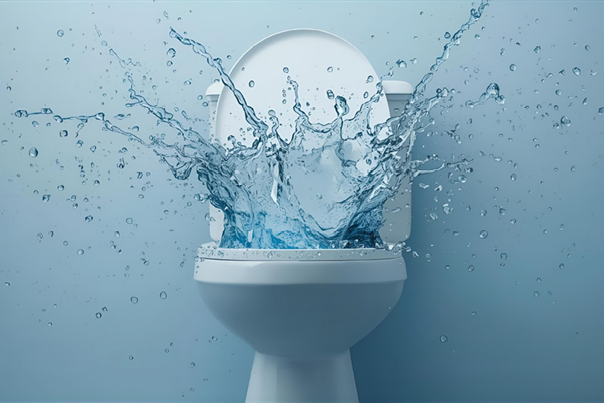
The sight of an ‘exploding’ toilet, especially on World Toilet Day (November 19), will either make you laugh, recoil in horror, or both, however behind this gurgling, bubbling mess lies a serious issue that carries with it not only foul odours, but the potential for disease as well.
The difficulties of balancing a drainage system in a high rise building, or skyscraper, has prompted much research in order to prevent sewer air bubbles blowing through the trap when positive pressures in the system are too high.
Such failures can carry potentially dangerous outcomes, as empty traps can cause pathogens to spread between floors in a tall building, especially in a single designed plumbing system, creating the potential for an infection outbreak.
Aliaxis UK’s Training and Research Centre, at the National Lift Tower, in Northampton, serves as a hub for innovation in high-rise plumbing systems and high rise drainage problems. It is perfectly placed for such work, housing the world’s tallest drainage testing installation - a 75m soil stack, which can recreate 40 flushes within the system to test real-life situations.
With exceptional technical capabilities, the facilities housed within the National Lift Tower attract industry professionals from across the globe, including building regulation inspectors, consultants, designers, international developers, M&E contractors, main contractors, and public health engineers.
It is this expertise in research and best practice that has seen Aliaxis UK create a suite of Continuing Professional Development programmes, including a CIBSE approved Active Drainage Ventilation in High Rise Buildings CPD.
Aliaxis UK utilises its vast experience to maximise the training potential and enhance the learning outcomes for the wider industry.
David Thomas, Aliaxis Head of Technical Services, said: “At Aliaxis, we are the global leader in designing innovative, reliable and sustainable solutions for fluid and energy management.
“Therefore, it is a natural progression for us to offer CPDs and lead the way in Active Drainage Ventilation in high rise buildings. The research centre further backs up our findings, due to the testing that takes place there, as well as demonstrating it to those who visit.”
Traps are an essential barrier when households are interconnected on the same pipe design. The trap seal acts as an integral part of the hygiene system in high-rise buildings and provides an essential barrier to minimise the possible infection risk due to the transmission of contaminants from the drainage system.
Fluctuating air pressures caused by the interaction of water and air within the system can disrupt trap seals. These transient pressures travel through the drainage network, altering airflow patterns and potentially drawing seal water from traps. To prevent seal loss and maintain system integrity, it is essential to implement measures that stabilise and regulate these short-duration pressure events.
David added: "Our CPD delves into the reasons high-rise buildings have issues as transient pressures lead to air blowing through traps and it will offer the reasoning for the solutions - how Active Drainage Ventilation attenuates any pressure immediately at the point of need, while also looking at systems, such as Studor and Positive Air Pressure Attenuator (P.A.P.A), and how they can provide a solution.”
Anyone undertaking the Active Drainage Ventilation CPD can visit the National Lift Tower in person or virtually using a VR headset.
The process to sign up for a CPD session is straightforward and simply involves completing an online application form, after which the sales team will liaise on dates, time, and place.
For more information about the Active Drainage Ventilation in High Rise Buildings CPD, and other CPDs offered by Aliaxis, please visit the relevant links.